
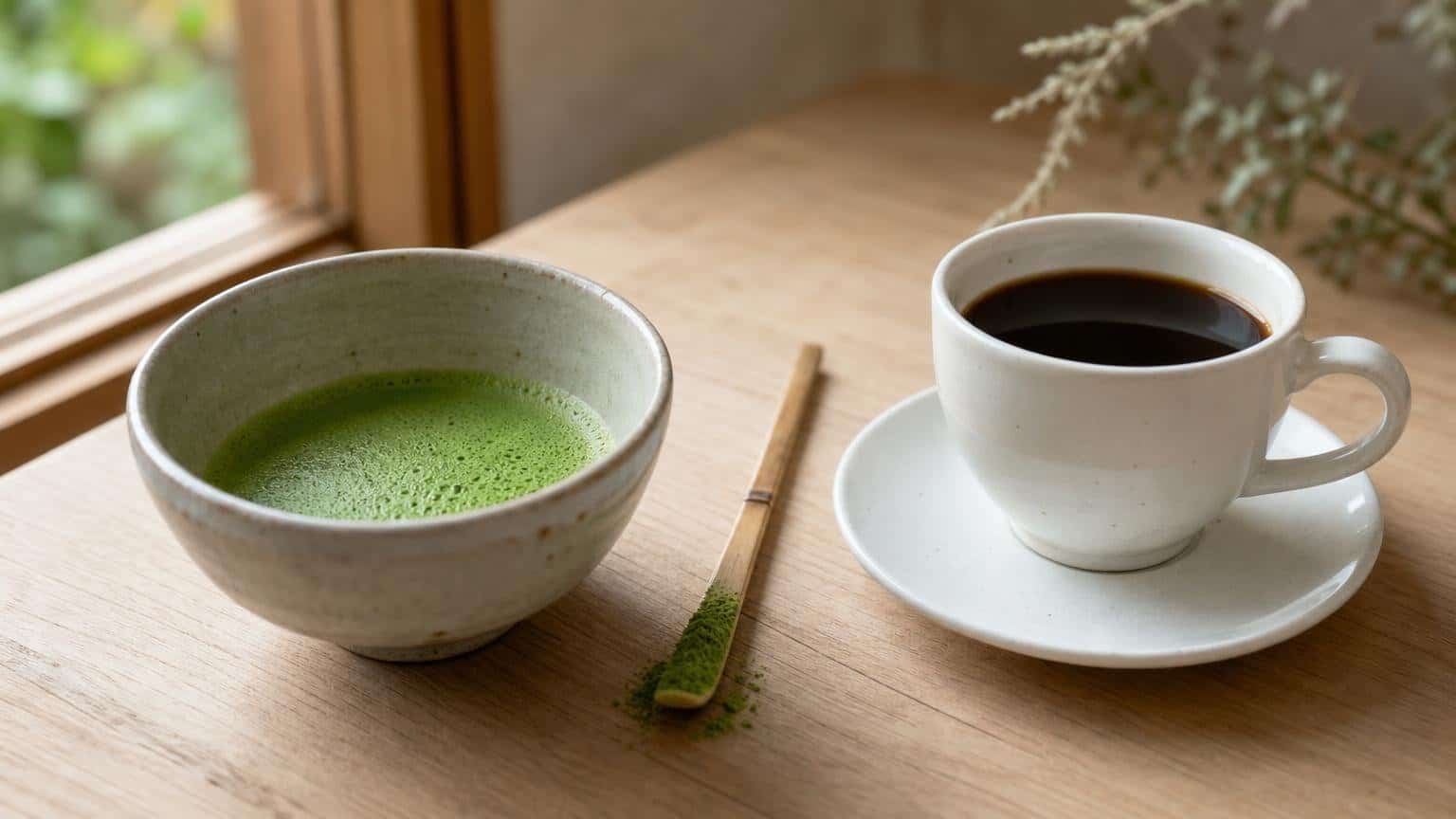
Matcha has caffeine, and because you drink the whole powdered leaf, the amount depends almost entirely on how much powder you use. Here is how much caffeine is in matcha per gram and per cup, how it compares with coffee and tea, and how much is considered safe, with every figure linked to its source.
In short: caffeine in matcha
- Japan’s official food tables list about 32 mg of caffeine per gram of matcha.
- A usual bowl of 2 g therefore has roughly 64 mg, a 3 g latte roughly 96 mg.
- Lab tests of matcha brands found about 26 to 35 mg per gram, depending on the product.
- The EU food safety authority considers up to 200 mg at once and 400 mg a day safe for healthy adults, and 200 mg a day in pregnancy.
How much caffeine is in a gram of matcha?
Japan’s Standard Tables of Food Composition, published by the education ministry, list 3.2 g of caffeine per 100 g of matcha powder, which is 32 mg per gram. Japan’s agriculture ministry uses the same figure in its information on caffeine.
Real products vary. A 2023 study in Plant Foods for Human Nutrition measured commercial green teas and found that ceremonial grade matcha averaged about 31 mg of caffeine per gram and culinary grade matcha about 26 mg per gram. The highest value, 35 mg per gram, came from a ceremonial matcha. Bagged and gunpowder green teas averaged about 23 mg per gram of leaf.
Caffeine per serving
To work out the caffeine in your cup, multiply the grams of powder by the caffeine per gram. Water or milk does not add or remove any, so a latte made with 3 g contains more caffeine than a bowl made with 2 g. The table uses the Japanese reference value of 32 mg per gram, so real cups can be somewhat lower.
| Matcha | Typical use | Caffeine (at 32 mg/g) |
|---|---|---|
| 1 g | A light, small bowl | about 32 mg |
| 1.5 g | Thin tea, Uji style | about 48 mg |
| 2 g | A standard bowl of usucha | about 64 mg |
| 3 g | A matcha latte | about 96 mg |
| 4 g | Thick tea, koicha | about 128 mg |
The amounts follow our guides on how to make matcha and how to make a matcha latte.
Matcha vs coffee and tea
The European Food Safety Authority gives these approximate values for other drinks: an espresso of 60 ml has about 80 mg of caffeine, a 200 ml cup of filter coffee about 90 mg, a 220 ml cup of black tea about 50 mg and a 355 ml can of cola about 40 mg. A 2 g bowl of matcha sits between black tea and coffee, while a 3 g matcha latte can match or exceed a cup of filter coffee.
How much caffeine is too much?
For healthy adults, the European Food Safety Authority concluded in 2015 that single doses of up to 200 mg and up to 400 mg spread over the day raise no safety concerns. These limits count caffeine from all sources together, so coffee, tea, cola, energy drinks and chocolate all add up.
- Pregnancy and breastfeeding: up to 200 mg a day from all sources is not a concern for the baby, according to EFSA. Germany’s Federal Institute for Risk Assessment gives the same advice.
- Children and teenagers: adult limits do not apply. EFSA uses about 3 mg per kilogram of body weight as a guide.
- Sleep: EFSA notes that about 100 mg close to bedtime can affect sleep in some adults, roughly one and a half bowls of matcha.
If you are sensitive to caffeine, pregnant, or taking medication, ask your doctor or pharmacist what is right for you. This article explains general figures and is not medical advice.
Does matcha caffeine feel different?
Many people say matcha gives them a calmer lift than coffee. The caffeine itself is the same molecule. What matcha adds is L-theanine, an amino acid that is studied for its effects on attention and relaxation. We look at what the research says in matcha and sleep.
Sources
- Ministry of Education, Culture, Sports, Science and Technology of Japan: Food Composition Database, matcha (16035).
- Ministry of Agriculture, Forestry and Fisheries of Japan: Information on caffeine intake (in Japanese).
- Meyer et al. (2023): Catechin composition, phenolic content, and antioxidant properties of commercially-available bagged, gunpowder, and matcha green teas. Plant Foods for Human Nutrition 78, 662–669.
- European Food Safety Authority: Caffeine. Safety assessment of 2015 and caffeine content of common drinks.
- German Federal Institute for Risk Assessment (BfR): Questions and answers on caffeine (in German).
Keep reading: matcha and sleep, what is matcha? and all matcha guides.